About Malaria
Malaria is not caused by a virus or a bacterium, but by protozoan blood parasites in the genus Plasmodium.. Of the 5 types of human malaria, P. falciparum and P. vivax are responsible for almost 95% of all infections worldwide.
Malaria is one of the three most common infectious diseases. It is transmitted by mosquitoes (mosquitoes of the genus Anopheles) and often poses a major economic and health challenge in the regions where it is present.
Between 200 and 250 million people become infected with the disease every year. The WHO estimates that 405,000 died from malaria in 2018. According to the 2019 WHO World Malaria Report, 50% of global cases (about 228 million) were attributable to only 6 countries:
- Nigeria ,
- Democratic Republic of the Congo ,
- Uganda,
- Côte d’Ivoire,
- Mozambique,
- Niger.
About 67% of the deaths were children. The most severely affected countries in the world are often also the poorest countries in the world. The CDC speaks of a “vicious circle of poverty and disease”. This widespread distribution leaves about 50% of the world’s population potentially at risk for malaria.
Distribution map of malaria
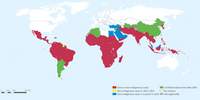
Source: World Malaria Report 2024
The transmission route of malaria
Malaria is caused by protozoan parasites of the genus Plasmodium and are transmitted by Anopheles mosquitoes.
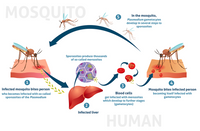
Transmission cycle
- Humans become infected through the bite of an infected Anopheles mosquito. During the feeding process, infectious sporozoites are release from the mosquito’s salivary glands and enter the bloodstream
- Sporozoites make their way to the liver where they invade liver cells. Within the liver cells the parasite multiples and transforms to a stage called merozoites. Infected cells eventually rupture releasing merozoites into the blood where the enter red blood cells.
- In the red blood cells, the parasites grow, eventually destroying the blood cells and the cycle of invasion and destruction continues.
- Reproductive stages of the parasite, male and female gametocytes, occur in some blood cells. When ingested by a biting mosquito, they mate in the gut of the mosquito forming an oocyst.
- Within the oocyst, sporozoites develop and eventually make their way to the salivary glands where the whole cycle repeats with the transfer of infectious sporozoites to a human during a mosquito bite
However, the risk of malaria transmission by mosquitoes should not be underestimated in other regions of the world that are not currently affected by the disease but where Anopheles mosquitoes are distributed. The “Malaria Atlas Project” of the WHO and Oxford University has defined so-called “Dominant Vector Species”. These 41 Anopheles species are characterized by the fact that they have the most efficient vectors in the geographic regions where they are found. In areas where malaria has been eliminated, but the vectors persist, there is, a potential risk for transmission should the pathogen be introduced.
Since human Plasmodium are blood parasites, transmission by vectors is not the only way to become infected. Blood transfusions, donor organs or contaminated syringes also pose a risk. Transmission from a mother to her child is also possible during pregnancy and delivery.
The disease
While there is no typical course of malaria, commonly a patient will report a combination of the symptoms below:
- Fever
- Chills
- Sweats
- Headaches
- Nausea and vomiting
- Body aches
- General malaise
The course of the disease differs depending on the causative pathogen.
The most common, but also the most severe form of the disease is caused by P. falciparum. The incubation period is between 7 to 15 days after infection. The initial symptoms are often accompanied by vomiting, cough, diarrhea and abdominal pain. In severe cases, symptoms related to organ failure may develop, such as acute renal failure, pulmonary edema and circulatory collapse. Cerebral malaria can occur when the disease attacks the central nervous system and the brain causing seizures, clouding of consciousness, coma and potentially, death. Falciparum malaria may be fatal if treatment is delayed beyond 24 h after the onset of clinical symptoms. Travelers to P. falciparum endemic areas should always consider malaria a possibility if a fever occurs around 7 days after return.
The second most common form of the disease is caused by P. vivax. The incubation period is about 12 to 18 days. After the initially general and unspecific symptoms, a typical alternating fever sets in and every 48 hours, the patient experiences violent fever spikes lasting 3 to 4 hours. The body temperature can rise extremely quickly to around 40°C and then fall again just as quickly, accompanied by outbreaks of sweating. The disease is well treatable today and is very rarely fatal.
Diagnosis
Malaria is typically diagnosed by identification of the parasites in a blood smear with microscopy. Rapid diagnostic tests (RDTs) are also available that can detect malaria antigens in the blood in about 15 minutes. These tests do not replace microscopy, but can be useful when a trained microscopist is unavailable.
Brief history of malaria
Malaria has been around for as long as humans have existed and so it has accompanied almost every episode of human history. The first written records of the disease can be found in Chinese documents as early as 2700 BC, in 2000 BC on Mesopotamian clay tablets or in 1570 BC on Egyptian papyrus. Almost 700 years later, an ancient Indian text even calls it the “king of diseases”. Malaria is mentioned in Homer’s Iliad in 850 BC as well as in the natural philosophy texts of Empedocles around 550 BC and Hippocrates around 400 BC. Around the same time, Aristotle, Plato and Sophocles are said to have written about it. Although the exact circumstances of his death are unclear, malaria is often discussed as a contributing factor in the death Alexander the Great in Babylon at the age of 32. About 200 years later, the Romans presumably brought the pathogen from Egypt and carried it as far north as England and Denmark. Malaria was a permanent feature of early European settlements. Around 1900, the pathogen had its largest distribution worldwide and was found in the tropics, subtropics and temperate latitudes of all continents, from Sweden, Russia and the USA in the north to Argentina, South Africa and Australia in the south.
Source: eigene Recherche und https://eu.biogents.com
